Cape Coral Mortgage Company: Fairview Lending

Quick Answer
No — you usually do not need two years with the same employer to qualify for a mortgage in Florida. Lenders review up to two years of employment history, but that history can span several employers, schooling or training. If you earn a fixed salary or regular hourly wage in the same line of work, your new job income can often be used within your first few weeks — sometimes before your first paycheck, using a signed offer letter. Variable income (overtime, bonus, commission, tips) and seasonal or self-employment income generally needs two years.
One of the most common mortgage questions we hear at Fairview Lending in Cape Coral is:
“Do I need to work for the same employer for two years before I can qualify for a mortgage?”
In many cases, the answer is no.
Mortgage lenders typically review your employment and income history, but that does not necessarily mean you must remain with one employer for two years. If you recently accepted a new job — especially in the same profession or line of work — you may be able to use your new income immediately.
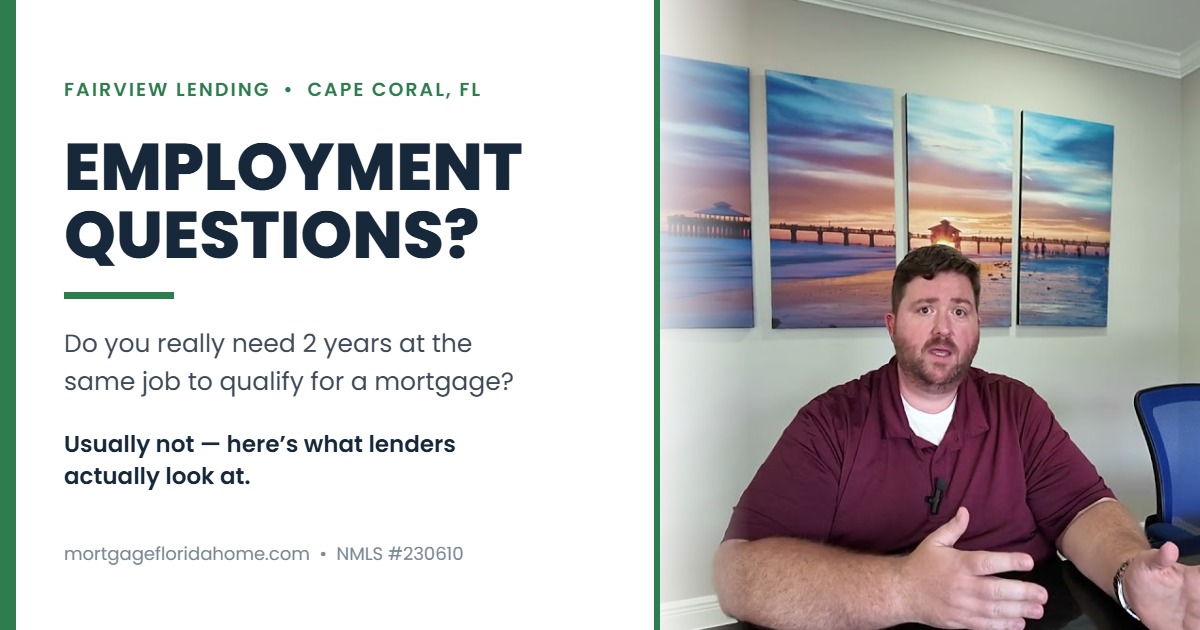
Watch: Do You Need 2 Years at Your Job to Qualify for a Mortgage?
Here is the short version, straight from our team:
Do You Need 2 Years at Your Job to Qualify for a Mortgage? — Fairview Lending, Cape Coral, FL. Watch on YouTube
Employment History at a Glance: How Much Do You Actually Need?
The history a lender needs depends far more on the type of income you earn than on how long you have been at your current desk. Here is the general framework used on most Florida home loans:
| Income Type | Typical History Needed | Can a Brand-New Job Work? |
|---|---|---|
| Fixed salary | No universal minimum; documented current employment | Often yes |
| Regular hourly (fixed hours) | No universal minimum; documented current employment | Often yes |
| Overtime, bonus, commission, tips | Generally 12 months minimum at current employer; 2 years history receiving. | Usually not |
| Seasonal income | Generally 2 years | Rarely |
| Self-employment | Generally 2 years; 12 months possible with qualifying prior experience | No |
| Part-time / second job | 24 month history of working both jobs is required | No |
General guidance only. Final requirements depend on the loan program, the automated underwriting findings and your complete financial profile.
Can I Get a Mortgage After Starting a New Job?
Potentially, yes.
Consider this example:
Scenario: You worked as a nurse at one hospital for three years. Two months ago, you accepted a salaried nursing position at a different hospital in Fort Myers.
Even though you have only been with your new employer for two months, you still have an established employment history in the nursing field. Depending on the loan program and your complete financial profile, your current salary may be eligible for mortgage qualification.
For conventional loans evaluated under Fannie Mae guidelines, base salary and fixed hourly income do not have a universal minimum history requirement. The lender must still document your current employment, your earnings, and the likelihood that the income will continue.
Do You Need Two Years With the Same Employer?
No. The frequently repeated “two-year rule” is often misunderstood.
Lenders may request up to two years of employment and income documentation, but those two years do not always need to be with the same company. Your history can include:
- Your current employer
- A previous employer
- More than one position within the same profession
- Certain periods of education or specialized training
- An acceptable explanation for an employment gap
What matters is whether the lender can document that your income is stable, reliable and reasonably expected to continue.
Does Changing Careers Make It Harder to Qualify?
A complete career change can require additional review, but it does not automatically disqualify you.
For example, moving from one salaried accounting job to another accounting job is generally easier to document than moving from a salaried position into commission-only sales or self-employment.
The lender may consider:
- Your previous occupation
- Your education or professional training
- Whether the new job has a guaranteed salary
- Whether your hours are fixed or variable
- The length of any employment gap
- The mortgage program being used
This is why it is helpful to speak with a mortgage professional before assuming you must wait.
How Common Job Changes Are Usually Viewed
| Your Situation | General Difficulty | What Underwriting Focuses On |
|---|---|---|
| Salaried job to a similar salaried job, same field | Straightforward | Offer letter, first pay stub, verification of employment |
| Promotion or raise with the same employer | Straightforward | New pay rate documentation |
| Relocating to Florida for a new salaried position | Usually workable | Executed offer, start date, whether income begins before closing |
| Recent graduate entering the field they trained for | Usually workable | Diploma or transcripts used in place of prior work history |
| Salary to commission-only or 1099 contractor | More review required | Length of variable-income history, tax returns |
| W-2 employee to newly self-employed | Not workable | 2 years of self employment income required |
| Returning to work after a gap | Usually workable | Letter of explanation, current stable employment, length of time back at work |
Salary and Hourly Income Versus Variable Income
The type of income you earn can be just as important as the amount you earn.
Fixed salary or regular hourly income
A new salary or regular hourly wage may sometimes be used shortly after you start a new position, provided the employment and income are properly documented.
Overtime, bonuses, commission and tips
Variable income usually requires a longer history because the lender must determine what amount is stable enough to use. Fannie Mae’s current guidance generally requires at least a 12-month history for variable income, while some income types or loan programs may require more.
Seasonal income
Seasonal income generally requires a documented two-year history because earnings naturally fluctuate throughout the year. This comes up often in Southwest Florida, where hospitality, tourism, landscaping and construction work can follow the season.
Self-employment income
Self-employed borrowers typically need a longer record of earnings. Fannie Mae ordinarily looks for a two-year history, although borrowers with at least 12 months of self-employment may sometimes be considered when they have qualifying previous experience and the required tax-return documentation.
What Documents Might You Need?
Depending on your situation, the lender may request:
| Document | When It Usually Comes Up |
|---|---|
| Recent pay stubs | Nearly every W-2 borrower |
| W-2 forms (often two years) | Nearly every W-2 borrower |
| Written or verbal verification of employment | New jobs and pre-closing verification |
| Signed employment contract or offer letter | Starting a job at or near closing |
| Personal and business tax returns | Self-employed, 1099 or commission income |
| Letter explaining an employment gap | Gaps of roughly 30 days or more |
| Diploma, transcripts or training records | Recent graduates and career changers |
The exact requirements depend on your loan program, employment structure and income type.
Should You Wait Before Applying for a Mortgage?
Not necessarily.
Many prospective homebuyers in Cape Coral, Fort Myers and throughout Southwest Florida delay applying because they recently changed jobs. They assume they must wait six months, one year or even two years before purchasing a home.
That assumption could unnecessarily delay your plans — and in a market where prices and rates both move, delay has a real cost. The better approach is to let a mortgage professional review your employment and income history. Even if you are not ready today, a proper review can identify what you need and give you a realistic path toward approval.
Southwest Florida Job Changes We See Every Month
Southwest Florida is a relocation market. A large share of our borrowers are moving here for work, or moving employers once they arrive. Situations we regularly help with:
- Cape Coral & North Fort Myers — trades and construction workers moving between builders, and healthcare staff transferring between hospital systems.
- Fort Myers & Lee County — nurses, teachers, first responders and airport/logistics employees changing employers within the same profession.
- Estero & Bonita Springs — corporate transfers and remote workers relocating from out of state with an executed offer letter in hand.
- Naples & Collier County — hospitality and service professionals with seasonal or tip-based income that needs a longer documented history.
- Punta Gorda & Port Charlotte — retirees returning to part-time work, and self-employed contractors establishing a Florida business.
- Lehigh Acres — first-time buyers moving from hourly to salaried roles.
If you are relocating to Florida and have not started your new job yet, that is a conversation worth having before you write an offer — not after.
Frequently Asked Questions
Can I qualify for a mortgage if I just started a new job?
Possibly. Borrowers with fixed salary or regular hourly income may be able to qualify soon after starting, particularly when they have related employment, education or training. The lender must document the new employment, the pay and the likelihood that it continues.
Do I need two years at the same job to buy a house in Florida?
No. Most loan programs look for up to two years of employment history, and that history can include multiple employers, positions within the same profession, or time spent in school or specialized training.
Can I change jobs during the mortgage process?
You should speak with your loan officer before changing jobs. A change in employer, pay structure, hours or occupation can affect your approval and may require new documentation. Lenders commonly re-verify employment shortly before closing.
Can I qualify while working a probationary period?
A probationary period does not necessarily prevent approval, but the lender must evaluate the employment terms, income and applicable program guidelines.
Can an employment offer letter be used to qualify?
Some mortgage programs may permit qualifying based on an executed employment offer or contract when specific requirements are satisfied. The start date, salary and employment conditions will be important, and some programs require the job to begin within a set number of days of closing.
What if I have an employment gap?
An employment gap does not automatically prevent you from obtaining a mortgage. The lender may request an explanation and documentation showing that you have returned to stable employment. Short gaps between jobs are common and are usually handled with a brief letter of explanation.
How long do I need to be self-employed to get a mortgage?
Two years is the ordinary expectation. Borrowers with at least 12 months of self-employment may sometimes be considered when they have qualifying prior experience in the same field and can provide the required tax-return documentation.
Does a raise or promotion at my current job help me qualify?
It can. A documented increase in base salary or hourly rate can often be used once the new pay rate is verified, which may increase the loan amount you qualify for.
I work two jobs. Can both incomes be used?
Often yes, though second-job and part-time income generally requires a track record — commonly 12 to 24 months — before it can be counted toward qualifying.
I am relocating to Southwest Florida. Can I buy before my job starts?
Sometimes. Certain programs allow qualification on an executed offer letter or contract before the first day of work, subject to strict conditions. Ask before you make an offer so you know which path applies.
Do FHA and VA loans handle new jobs differently than conventional loans?
Each program has its own employment and income rules, and they are not identical. A situation that requires extra documentation under one program may be more straightforward under another — which is one advantage of working with a broker who can place your loan with multiple lenders.
What if my income is commission or bonus based?
Variable income generally requires at least a 12-month documented history so the lender can determine a stable, usable amount. Your base salary may still qualify you on its own while the variable portion seasons.
Talk With a Southwest Florida Mortgage Professional
Every borrower’s situation is different. The fastest way to determine whether your current income can be used is to complete a mortgage pre-approval or have Fairview Lending review your employment scenario.
We help homebuyers in Cape Coral, Fort Myers, Estero, Bonita Springs, Naples, Lehigh Acres, Punta Gorda, Port Charlotte and communities throughout Southwest Florida understand their financing options.
Already have a pre-approval from another lender? Get a free second opinion.
Fairview Lending has served Southwest Florida homebuyers for 20 years and has earned more than 180 five-star local Google reviews. If another lender told you to wait two years because of a job change, we will review your scenario at no cost and with no obligation — and tell you straight whether your income can be used today.
Fairview Lending Inc — NMLS #230610
1425 Del Prado Blvd S, Cape Coral, FL 33990
Phone: (239) 829-1543
Hours: Mon–Fri 8:00 AM–8:00 PM · Sat 9:00 AM–5:00 PM · Sun 10:00 AM–4:00 PM
Loan approval, income eligibility and documentation requirements depend on the loan program and the borrower’s complete financial profile. Guidelines referenced reflect general industry and agency standards and are subject to change. This article is for informational purposes and is not a commitment to lend. Fairview Lending Inc, NMLS #230610. Equal Housing Opportunity.