

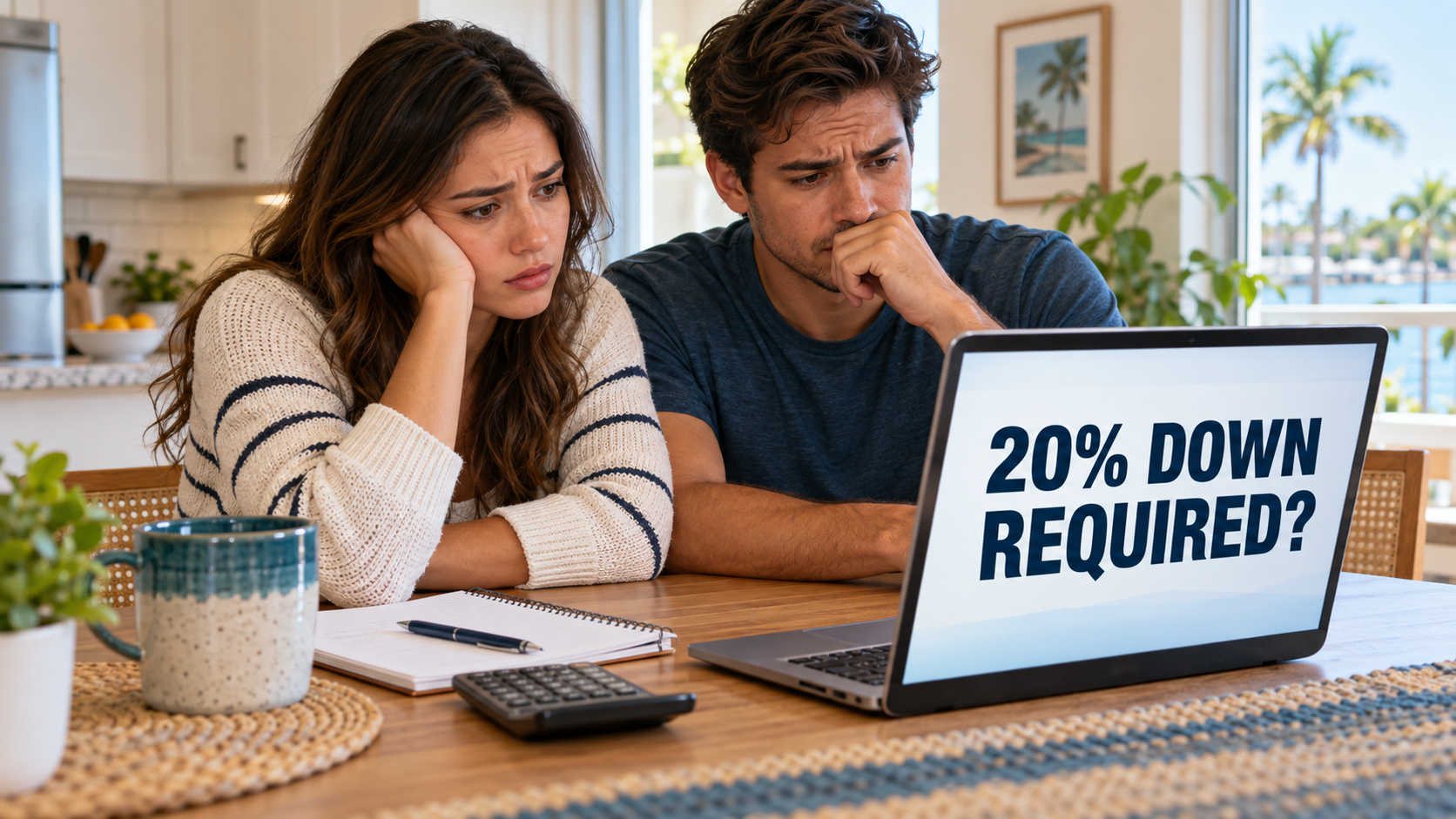
If you’re waiting to save 20% before speaking with a lender, you may be waiting longer than you need to. You generally do not need 20% down to buy a house in Florida. Eligible first-time homebuyers may qualify for a conventional or FHA mortgage with a low down payment, and eligible veterans may qualify for a VA loan with no down payment required.
For buyers in Cape Coral, Fort Myers, and Southwest Florida, the better question is: What will my total monthly payment and cash needed to close look like with each option?
Updated September 24, 2026 · Fairview Lending Inc, NMLS #230610 · Cape Coral, FL
Key takeaways
- 20% down is not a minimum. It is the point where a conventional loan generally no longer requires private mortgage insurance (PMI).
- No down payment required for eligible veterans and service members using a VA loan. USDA financing may also offer no-down-payment options in eligible areas.
- Conventional and FHA programs allow a low down payment for qualified buyers, usually with mortgage insurance.
- The down payment is not your only cost. Budget for closing costs, prepaid items, homeowners insurance and, in much of Southwest Florida, flood insurance.
- Compare the full picture: cash needed to close and total monthly payment for each loan option, before you make an offer.
Watch: Do you really need 20% down to buy a home in Florida?
In this 40-second video, Fairview Lending tackles the most common homebuying myth we hear: that you must have 20% down. Eligible veterans may be able to buy with no down payment, other loan programs allow a low down payment, and down payment assistance may help qualified buyers with part of the down payment or closing costs. The main reason to put 20% down on a conventional loan is to avoid PMI. Watch on YouTube · Subscribe to Florida Mortgage Made Simple
Why does everyone say you need 20% down?
Twenty percent is a common benchmark because a conventional loan with 20% down generally does not require private mortgage insurance, or PMI. A larger down payment also means borrowing less and may improve the loan terms available to you.
But 20% is not a universal minimum. Many buyers put less down so they can keep money available for moving, repairs, and emergencies.
How much down do first-time homebuyers actually need?
| Loan option | Down payment | What to know |
|---|---|---|
| Eligible conventional loan | A low down payment for eligible buyers | PMI commonly applies below 20% down. |
| FHA loan | A low down payment | FHA mortgage insurance applies. |
| Eligible VA purchase loan | No down payment required for eligible borrowers | Closing costs and a VA funding fee may still apply. |
| Eligible USDA guaranteed loan | No down payment required in eligible areas | Household income and property-location rules apply. |
These are possible program minimums, not a promise of approval. Your required down payment depends on your finances, the property, the loan program, and the lender’s requirements.
Conventional loans: Could a low down payment work for you?
Some conventional purchase programs allow eligible first-time buyers to make a low down payment. Other conventional options may call for a larger down payment. We can compare the programs available for your circumstances rather than assume every conventional buyer needs 20%. Learn more about conventional loans in Florida.
With less than 20% down, conventional loans commonly include PMI. That is a cost to consider, but it does not necessarily last for the entire loan. Depending on the mortgage and its requirements, you may later be able to request PMI cancellation.
FHA loans: How low can the down payment be?
An FHA-insured purchase loan can allow an eligible borrower to make a low down payment. FHA financing may be worth comparing if you want a smaller down payment or your credit profile makes conventional options less attractive.
FHA loans have mortgage insurance costs, including an upfront premium and an annual premium. That is why it helps to compare the full monthly payment and overall cost, rather than choosing based on the down payment alone. Borrower, property, and underwriting requirements apply. See how the two compare in our FHA vs. conventional loan guide, or read more about FHA home loans.
VA loans: Can an eligible buyer really put zero down?
Yes. A VA-backed purchase loan often requires no down payment when the sale price does not exceed the home’s appraised value and other requirements are met. VA loans do not require monthly mortgage insurance.
An eligible buyer may still need money for closing costs. A one-time VA funding fee may also apply unless the borrower qualifies for an exemption. VA eligibility does not replace the lender’s review of income, credit, and the property. Read our guide to VA home loans in Florida.
What about USDA loans?
USDA’s guaranteed loan program can offer no-down-payment financing for eligible buyers and properties in eligible areas. Household income and other requirements apply, and eligibility can change from one address to the next.
USDA is worth knowing about, but we would confirm the specific property and participating-lender availability before treating it as an option for your purchase.
How does the size of your down payment change the numbers?
A smaller down payment means less cash up front, but a larger loan amount and, usually, mortgage insurance. A larger down payment means more cash up front and a smaller loan, and on a conventional loan, reaching 20% generally avoids PMI.
The down payment is only one piece. It does not include closing costs, mortgage insurance, funding fees, interest, taxes, homeowners or flood insurance, HOA dues, or the monthly payment. A loan with no down payment could still require cash to close. We can run side-by-side numbers for the home you are considering.
Is the down payment all the cash you need to buy?
Usually, no. You should plan for closing costs and prepaid expenses in addition to your down payment. These may include title charges, appraisal and lender charges, taxes, insurance premiums, and money collected to establish an escrow account.
The Consumer Financial Protection Bureau says closing costs, excluding the down payment, typically range from 2% to 5% of the purchase price. Your actual costs may differ. Our guides to closing costs and how much money you need to buy a home break this down further. Seller credits, eligible gifts, or assistance programs may help with some costs when the transaction and loan rules allow them.
In Southwest Florida, it is especially helpful to examine homeowners insurance, possible flood insurance, property taxes, and HOA or condominium dues when estimating the full housing payment. A low down payment alone does not tell you whether the monthly payment fits your budget.
Is it better to make a low down payment or put 20% down?
There is no single answer for every buyer. Putting more down can reduce the amount you borrow. On a conventional loan, reaching 20% down can also avoid PMI. Putting less down may leave you with more cash after closing.
The comparison should include your cash needed to close, full monthly payment, mortgage insurance, available savings, and longer-term plans.
At Fairview Lending, we can review the purchase price you have in mind, your available funds, income, debts, and property type. Then we can walk through the loan options that may fit. It is useful to do this before making an offer, while you still have time to plan for the payment and closing funds. A pre-approval is the right place to start.
Related Florida homebuyer guides
- How much money do I need to buy a home in Florida?
- FHA vs. conventional loans in Florida
- What credit score do I need to buy a home?
- What are closing costs?
- How to prepare to buy a home in Florida: 3 things every first-time buyer should do
- Florida mortgage FAQs
Find out what buying could look like for you
If you have been putting off a home purchase because you thought 20% down was mandatory, let’s run the real numbers. Contact Fairview Lending in Cape Coral to compare the down payment, estimated cash needed to close, and full monthly payment for loan options that may fit your goals. We work with homebuyers across Southwest Florida and elsewhere in Florida where eligible.
Fairview Lending has served Southwest Florida homebuyers for 20 years and has earned more than 180 five-star Google reviews. Already pre-approved with another lender? We offer a free, no-obligation second opinion on your pre-approval. Call (239) 829-1543, visit our office at 1425 Del Prado Blvd S, Cape Coral, FL 33990, or start your application online.
We help buyers in Cape Coral, Fort Myers, Estero, Naples and Lehigh Acres, and we are licensed throughout Florida. ¿Prefiere hablar en español?
Frequently asked questions about down payments in Florida
No. Eligible buyers may qualify for a conventional or FHA loan with a low down payment, and eligible veterans may qualify for a VA loan with no down payment required. The applicable program and lender determine what you actually qualify for.
No. A first-time buyer may qualify for conventional, FHA, VA, or another available program. Comparing options can reveal differences in mortgage insurance, monthly payment, and cash needed at closing.
A zero down payment is different from zero cash to close. Even a loan with no down payment can have closing costs and prepaid expenses. Permitted credits or other sources may offset some costs, depending on the transaction and program rules.
It depends on the loan. Conventional financing commonly requires PMI below 20% down. FHA loans have their own mortgage insurance premiums. VA loans do not require monthly mortgage insurance, although a funding fee may apply.
Some buyers may be eligible for down payment or closing cost assistance. Funding, income limits, property rules, borrower requirements, and participating lenders vary. It is best to check what is currently available for your situation before counting on assistance.
Often, no. A VA-backed purchase loan typically requires no down payment for eligible veterans, active-duty service members and qualifying surviving spouses when the sale price does not exceed the appraised value and other requirements are met. Closing costs and a one-time VA funding fee may still apply unless the borrower is exempt. Learn more about VA home loans.
Plan for closing costs and prepaid items on top of any down payment. The Consumer Financial Protection Bureau says closing costs typically run 2% to 5% of the purchase price, excluding the down payment. In Southwest Florida, homeowners insurance, flood insurance, property taxes and HOA dues can meaningfully change both your cash to close and your monthly payment. Your Loan Estimate shows your actual figures.
Many loan programs allow eligible gift funds from a relative or other acceptable donor toward the down payment or closing costs. The gift usually has to be documented with a gift letter and a record of the transfer. Rules vary by program, so talk with your loan officer before any money moves.
Not necessarily. Saving 20% can help you avoid mortgage insurance on a conventional loan, but while you save, home prices, rents and rates can change. Compare the cost of mortgage insurance with what waiting may cost you, and keep enough savings for emergencies after closing. We can run both scenarios for you.
Educational information, not a commitment to lend or a guarantee of terms or approval. Program availability, eligibility, pricing, lender requirements, and property requirements are subject to change. Fairview Lending is an independent mortgage broker and is not affiliated with or endorsed by HUD, FHA, VA, USDA, or Fannie Mae; these materials were not approved by any government agency. Down payment assistance programs are administered by third parties, have limited funding and their own eligibility requirements, may be repaid as a subordinate loan, and may change or end without notice. Fairview Lending Inc, NMLS #230610. Equal Housing Opportunity.