Cape Coral Mortgage Company: Fairview Lending

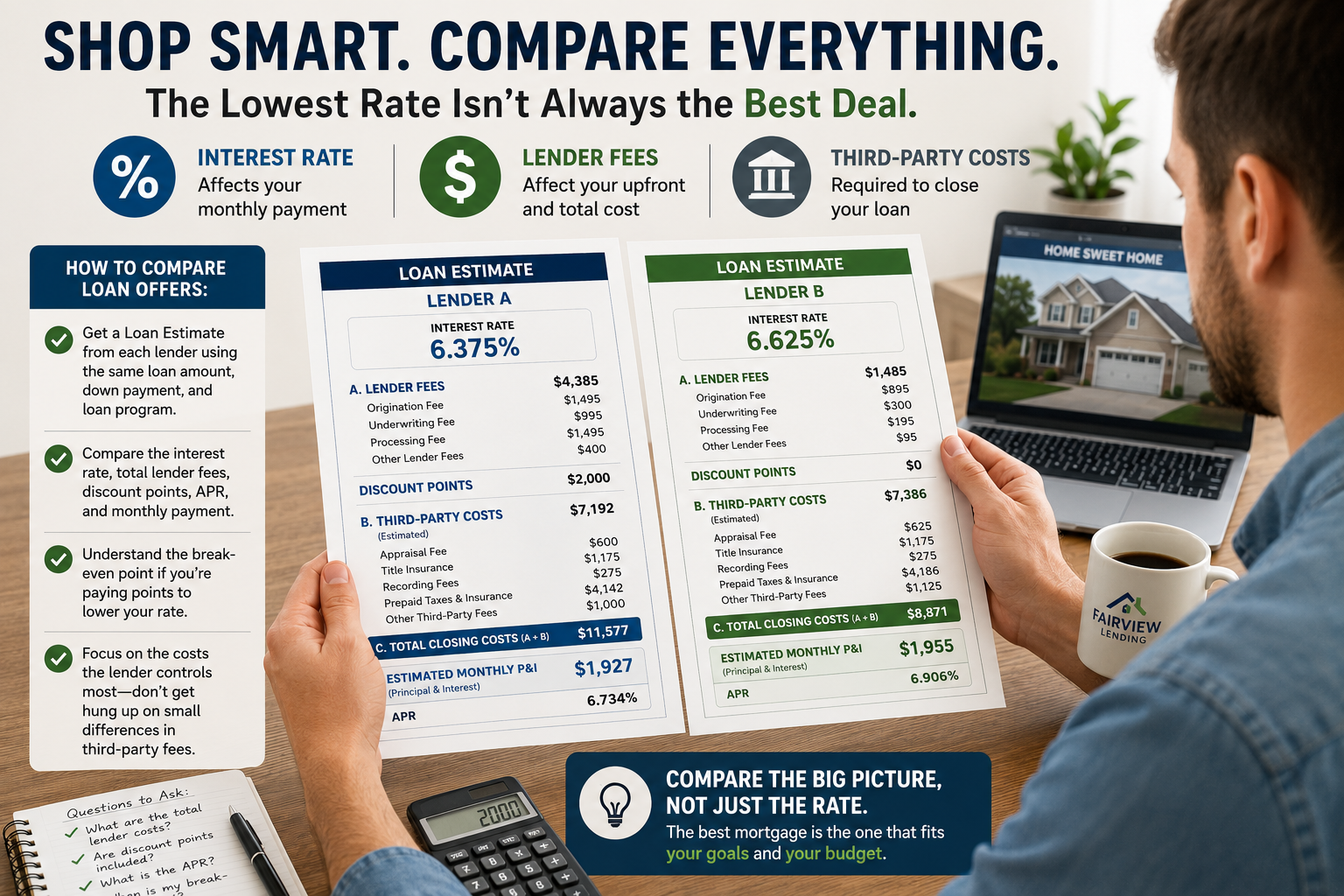
When you shop for a mortgage rate in Florida, the rate you are quoted is only one part of what the loan will actually cost you. If you’re buying a home or refinancing, you’ve probably heard the advice:
“Shop around for the lowest interest rate.”
While that’s good advice, it’s only half the story.
The truth is that a mortgage has three major categories of costs:
- The interest rate you pay each month.
- The lender’s charges to originate your loan.
- Third-party closing costs that are required to complete your transaction.
Many borrowers focus entirely on the first number and overlook the other costs. That’s a mistake that can cost thousands of dollars.
At Fairview Lending, we believe borrowers should understand all three before choosing a lender. If you have not started yet, begin with our guide to preparing to buy a home in Florida, then read what happens to your rate after pre-approval.
A Lower Interest Rate Usually Isn’t Free
Mortgage interest rates aren’t simply assigned at random.
In most cases, borrowers can choose from a variety of rate options. For example:
- 6.75%
- 6.625%
- 6.50%
- 6.375%
As the rate gets lower, the upfront cost often increases.
One lender may advertise a 6.25% rate but require several thousand dollars in discount points or lender fees to obtain it.
Another lender may offer 6.50% with little or no upfront cost.
Which loan is actually better?
The answer depends on how long you expect to keep the mortgage and how much you’re paying to obtain that lower rate.
Understanding Mortgage Fees
When comparing Loan Estimates, borrowers often notice fees with names like:
- Origination Fee
- Underwriting Fee
- Processing Fee
- Administrative Fee
These fees are all part of the lender’s compensation for originating and closing your loan.
Every lender structures these charges differently.
One lender might charge:
- $1,495 Origination Fee
- $995 Underwriting Fee
- $795 Processing Fee
Another lender might simply charge:
- $3,285 Origination Fee
The names may be different, but the total cost can be very similar.
This is why comparing a single fee—or a single interest rate—doesn’t tell the whole story.
Not Every Fee on a Loan Estimate Comes From the Lender
One of the biggest misconceptions we see is borrowers comparing every line on a Loan Estimate as though each fee is set by the lender.
In reality, many closing costs are third-party charges that the lender doesn’t control.
These can include:
- Appraisal fees
- Credit report fees
- Flood certification fees
- Title insurance
- Settlement or closing fees
- Government recording fees
- Transfer taxes (where applicable)
- Homeowners insurance premiums
- Property taxes
- Initial escrow deposits
Many of these costs are determined by third-party companies, local governments, or the property itself—not the lender.
For example, title insurance rates in Florida are largely regulated by the state, county recording fees are set by local government, and your homeowners insurance premium depends on the property and insurance company you choose.
Could one lender estimate these costs differently than another? Yes. However, differences in these estimates usually aren’t a meaningful reason to choose one lender over another.
Instead, pay the closest attention to the costs your lender actually controls:
- Interest rate
- Discount points
- Origination charges
- Underwriting fees
- Processing fees
- Other lender fees
Those are the numbers that truly separate one mortgage offer from another.
Don’t Shop for a Mortgage Rate in Florida on Rate Alone
One of the biggest mistakes borrowers make is calling several lenders and asking:
“What’s your rate today?”
That question is almost impossible to answer accurately without additional information.
Mortgage pricing depends on factors such as:
- Credit score
- Down payment
- Loan amount
- Property type
- Occupancy
- Loan program (Conventional, FHA, VA, USDA)
- Debt-to-income ratio
- Whether you’re paying discount points
Two borrowers applying on the same day can legitimately receive different rates.
Even two lenders quoting the same borrower may intentionally quote different combinations of rates and fees.
The Best Way to Compare Mortgage Offers
Instead of comparing advertised rates, compare Loan Estimates.
A Loan Estimate is a standardized document required by federal law that allows borrowers to compare offers from different lenders.
When reviewing Loan Estimates, pay close attention to:
Interest Rate
This determines your monthly principal and interest payment.
Discount Points
These are optional costs paid upfront to reduce your interest rate.
Sometimes they make financial sense.
Sometimes they don’t.
Total Lender Fees
Compare the lender’s charges—not just the names of the fees.
One lender may bundle everything into one origination fee while another separates underwriting and processing fees.
Compare the total amount.
APR (Annual Percentage Rate)
APR includes the interest rate plus certain loan costs, making it a useful comparison tool.
However, APR isn’t perfect because it assumes you’ll keep the loan for a specific period of time. It’s best used alongside the actual lender fees—not instead of them.
Should You Pay Points to Get a Lower Rate?
Sometimes yes.
Sometimes no.
For example:
If paying $3,000 today saves you only $35 per month, it would take more than seven years just to recover your investment.
If you expect to move, refinance, or pay off the loan before then, paying those points may not make financial sense.
This is known as your break-even point, and it’s something every borrower should understand before buying down an interest rate.
The Lowest Rate Isn’t Always the Best Deal
Imagine these two options:
Option A
- Lower interest rate
- $5,000 in lender costs
Option B
- Slightly higher interest rate
- $500 in lender costs
Depending on your goals, Option B could actually save you money.
That’s why experienced loan officers don’t simply recommend the lowest rate—they help determine the most cost-effective option for your unique situation.
Work With Someone Who Explains Your Options
A good mortgage professional shouldn’t pressure you into one interest rate or another.
Instead, they should explain:
- Multiple rate options
- The cost of each option
- Monthly payment differences
- Break-even analysis
- Whether paying points makes financial sense
- Exactly which fees are controlled by the lender—and which aren’t
Every borrower’s goals are different.
Someone planning to stay in a home for 20 years may make a different decision than someone expecting to relocate in five years.
Let Fairview Lending Help You Compare Mortgage Offers
At Fairview Lending, we believe informed borrowers make better decisions.
Whether you’re comparing lenders, trying to understand discount points, or wondering whether a lower interest rate is worth the additional cost, we’re happy to walk through the numbers with you.
We’ll explain your Loan Estimate line by line, help you compare competing offers apples to apples, and make sure you understand exactly what you’re paying for—so you can choose the mortgage that’s the best fit for your financial goals, not simply the one advertising the lowest rate.
Have questions about a mortgage quote you’ve received? Contact Fairview Lending today. We’re happy to help you compare mortgage offers with no pressure and no obligation.
The Bottom Line on How to Shop for a Mortgage Rate in Florida
In short, the smartest way to shop for a mortgage rate in Florida is to compare complete offers instead of headline numbers. Because lender fees and discount points move independently of the rate itself, two loans quoted at the same rate can cost very different amounts. Also worth reading: the Consumer Financial Protection Bureau explains the different kinds of mortgage loans available and how to prepare to shop for your mortgage. However you proceed, ask every lender for a written Loan Estimate so you can shop for a mortgage rate in Florida on equal terms.
Not necessarily. A lower interest rate often comes with higher upfront costs, such as discount points or lender fees. Depending on how long you plan to keep your mortgage, paying more upfront for a slightly lower rate may actually cost you more in the long run. It’s important to compare both the interest rate and the total lender costs.
Look beyond the interest rate and compare all lender charges, including origination fees, underwriting fees, processing fees, administrative fees, and any discount points. The best way to compare offers is by reviewing the official Loan Estimates from each lender, which use a standardized format.
Ask each lender for a Loan Estimate based on the same loan amount, down payment, and loan program. Then compare the interest rate, total lender fees, discount points, estimated monthly payment, and APR. An experienced loan officer can also help you calculate the break-even point to determine whether paying more upfront for a lower rate makes financial sense.
Not every fee on a Loan Estimate is controlled by the lender. Costs such as title insurance, appraisal fees, government recording fees, prepaid taxes, and homeowners insurance are typically charged by third parties or are based on your specific property. While these estimates may vary slightly, they’re usually not where you’ll find meaningful savings. When comparing mortgage offers, focus primarily on the interest rate, discount points, and lender fees—the items that the lender actually controls.